
Key Takeaways
- A turnkey asset management platform (TAMP) can replace portions of core investment operations, but the analytical and communication work that supports new client acquisition often remains with the advisory firm, depending on the provider and service model.
- The headline TAMP platform fee is only one layer of the total cost; evaluate the full stack, including strategist fees and the operational cost of workflow gaps.
- Assess platform governance as a spectrum, not a binary choice. Understand how much flexibility advisors retain to customize portfolios within the platform's framework.
- Data portability and exit logistics are critical due-diligence items. Evaluate how easily you can access machine-readable historical data if you need to transition away from the platform.
- Evaluate prospect-facing analysis and proposal capabilities separately from ongoing portfolio reporting, since these functions may vary meaningfully across TAMP providers and programs.
An advisory firm's evaluation of a turnkey asset management platform typically concentrates on three areas: the investment menu, model performance track records, and platform pricing. But as many firms discover months or years into a relationship, the infrastructure decisions that shape an advisor's daily workflow and the firm's long-term flexibility often receive far less attention during due diligence.
Consider an illustrative scenario: a growing RIA evaluates several TAMP providers, compares their model performance and headline fees, and selects a partner. Six months later, the team finds that the platform's standard reports are ill-suited for prospect conversations, the fee structure is more complex than the initial proposal suggested, and migrating client data to another provider would require a significant operational effort.
The issue is not a failure of investment selection, but a gap in operational evaluation. The most consequential aspects of a TAMP relationship often lie not in the investment models themselves, but in the underlying infrastructure that governs how advice is prepared, presented, and supported.
This guide moves beyond the basics of what a TAMP is. It focuses on the under-evaluated dimensions of workflow, governance, cost structure, and data management that determine how well a platform supports an advisory firm's ability to grow.
What a TAMP Operationally Replaces and What It Does Not
Most descriptions frame the TAMP value proposition as "outsourcing investment management," but the operational reality is more granular. A TAMP may assume responsibility for a specific set of investment operations, but the advisory firm retains fiduciary oversight of outsourced functions along with the core responsibilities of client discovery, risk assessment, client fit, and the communication of value. The gap between a TAMP's reporting for existing clients and the comparative portfolio analysis a prospect conversation may require can become a capacity constraint if those capabilities sit outside the platform or are handled in a separate workflow.
For instance, consider an illustrative scenario in which an advisor assumes their new TAMP will handle all portfolio-related preparation. They may discover that analyzing a prospect's held-away assets , comparing them to the TAMP's proposed models, and generating a client-ready proposal requires capabilities or workflows that are outside the platform's standard scope. This distinction between what the platform automates and what the advisor must still prepare is central to a realistic evaluation.
The Operational Surface Area TAMPs Typically Cover
A TAMP may take on some of the operational functions that support the execution of an investment strategy, depending on the provider and service arrangement. This can include:
- Model Portfolio Management: Constructing, maintaining, and updating proprietary or third-party investment models.
- Rebalancing and Trade Execution: Monitoring portfolios for drift and executing trades to realign them with target allocations. This often involves processes such as block trading allocation and defined trade rotation policies.
- Billing and Fee Calculation: Calculating and processing advisory fees, often with capabilities for sleeve-level billing in more complex account structures like a Unified Managed Account (UMA).
- Performance Reporting: Generating standardized quarterly or monthly reports that summarize account performance, holdings, and asset allocation for existing clients.
- Custodial Integration: Connecting to one or more custodians to receive account data and transmit trading instructions.
The scope of these services varies. Different providers define this operational boundary differently. Some offer sophisticated overlay management, while others focus on delivering model portfolios. The distinction between a TAMP acting as a sub-advisor versus operating under a model-delivery arrangement also has direct implications for who holds trading discretion and bears best-execution obligations.
The Workflow Responsibilities That Remain with the Advisor
Even with a TAMP in place, the advisory firm retains the critical client-facing and strategic responsibilities that define its value. This residual workflow is where differentiation occurs and includes:
- Client and Prospect Discovery: The entire fact-finding process to understand a client's financial situation, goals, and circumstances.
- Risk Profiling and Client Fit: Assessing a client's risk tolerance and documenting how a recommendation aligns with the client's objectives and circumstances, consistent with the firm's fiduciary duty and duty of care.
- Investment Policy Statement (IPS) Alignment: Ensuring the selected TAMP model aligns with the client's documented investment policy.
- Comparative Portfolio Analysis: The analytical work required to evaluate a prospect's current portfolio of held-away assets against a proposed strategy.
- Communication of Value: Articulating the rationale behind the investment strategy and demonstrating how it connects to the client's objectives.
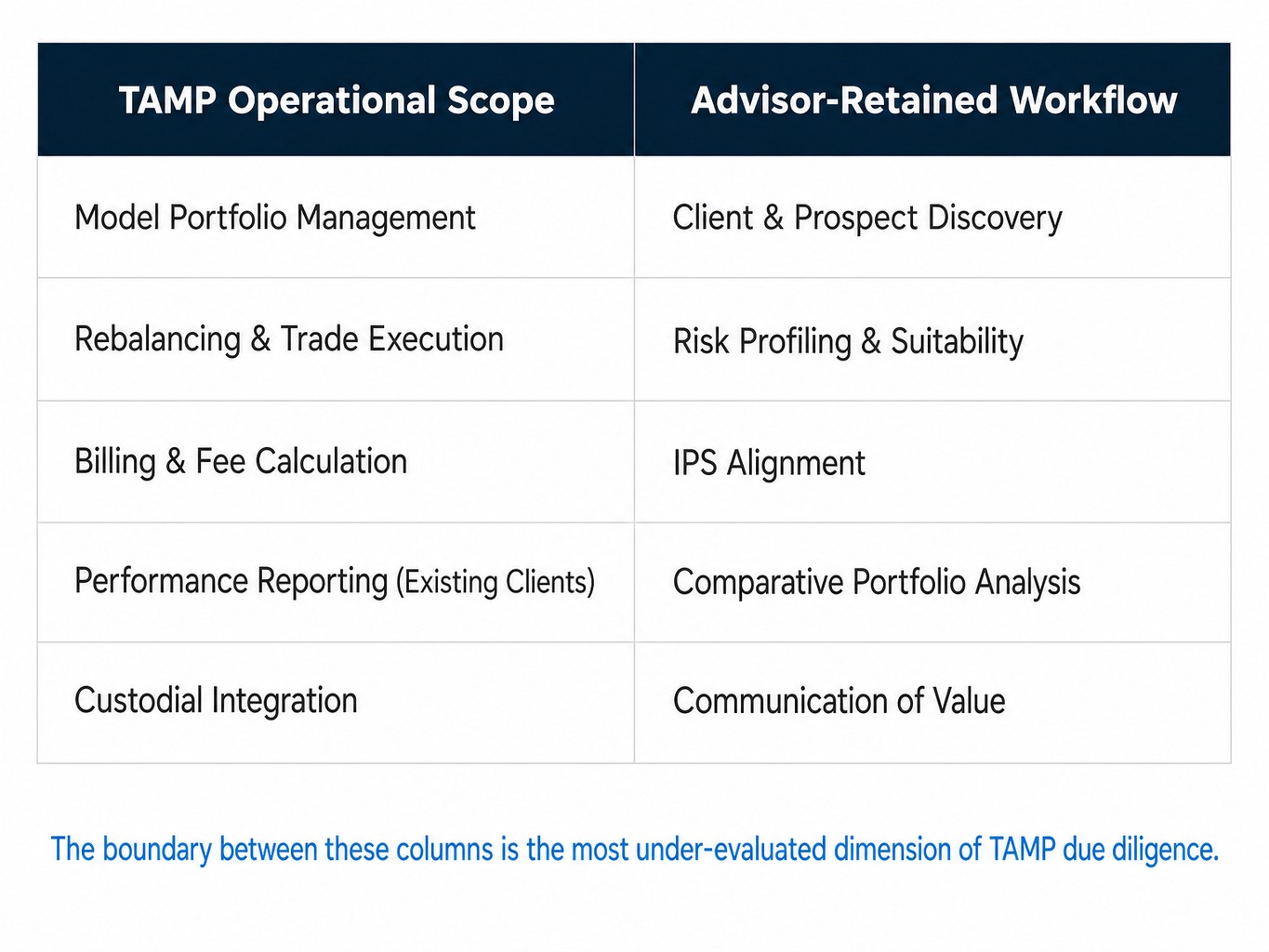
A TAMP addresses part of the operational engine of investment management, but it does not necessarily provide the infrastructure for every analytical and communication workflow that supports client acquisition and engagement. Recognizing this boundary is the first step toward a more complete evaluation.
The Fee Stack Beyond the Platform Fee
The headline TAMP platform fee, often quoted in basis points, represents only one layer of the total cost a client bears. A comprehensive due-diligence process involves mapping every component of the fee stack to understand the all-in cost of advice and how it compares across different providers.
Consider an illustrative scenario: an RIA selects a TAMP with a low platform fee, only to discover during implementation that the model portfolios use share classes with embedded fees and the billing engine cannot net the advisor's fee against the platform fee at the account level. The total cost to the client may end up higher than anticipated, prompting the firm to revisit how it presents all-in cost. The lesson is not about negotiation skill. It is about the structural opacity of layered fee arrangements that only becomes visible when every cost the client bears is mapped clearly.
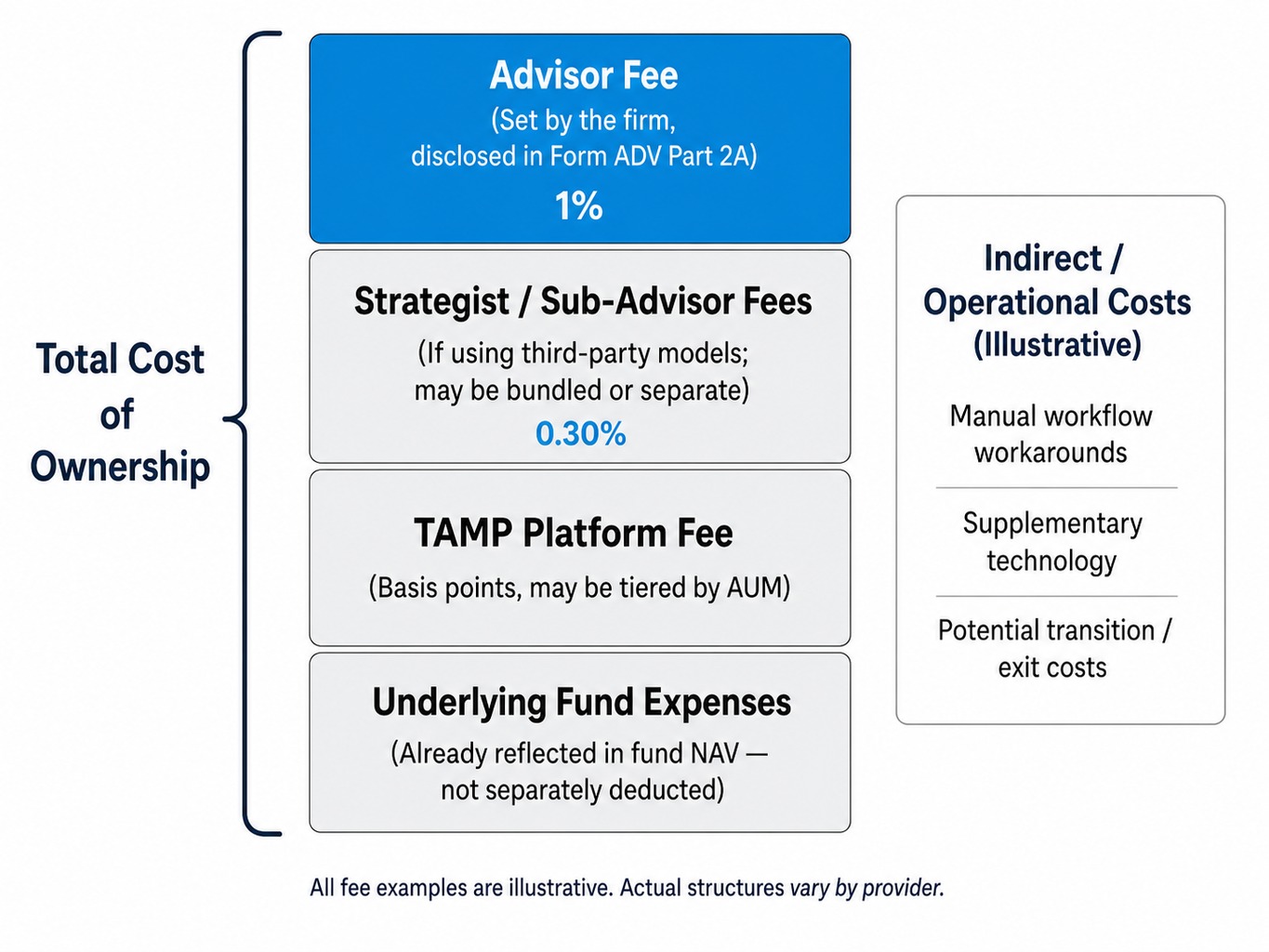
A hypothetical client with a 1% advisory fee and a 0.30% TAMP platform fee may pay 1.30% in separately charged advisory and platform fees, plus any underlying investment expenses. Understanding which costs are billed separately and which are embedded within the investment products is crucial.
Mapping the Layers: Platform Fees, Strategist Fees, and Fund Expenses
Evaluating total cost begins with deconstructing the fee stack. The layers typically include, although some fees may be bundled, waived, offset, or otherwise incorporated into the overall program fee:
- Advisor Fee: This is the fee the advisory firm charges for its services, as disclosed in its Form ADV Part 2A. It is set by the firm, not the TAMP.
- TAMP Platform Fee: This is the fee for using the platform's technology, trading, reporting, and operational services. It is often charged in basis points and may be tiered based on assets.
- Strategist or Sub-Advisor Fees: If the firm uses third-party models from the TAMP's marketplace, an additional strategist fee may apply. This fee compensates the manager who designed and maintains the model. It can be billed separately or be part of an all-inclusive program fee.
- Underlying Fund Expenses: These are the expense ratios of pooled investment products such as ETFs and mutual funds used within the models. It is important to note that these expenses are already reflected in a fund's Net Asset Value (NAV) and performance. They are not an additional fee deducted from the client's account in the same way as the advisory and platform fees. Other investments may involve different embedded costs.
TAMP billing engines also vary significantly in whether they can calculate fees on a household basis versus an account basis, a distinction that affects how firms implement tiered fee schedules for multi-account relationships.
Evaluating Total Cost of Ownership Across Providers
A true comparison of TAMP costs must extend beyond platform basis points to a broader concept of Total Cost of Ownership (TCO). This includes not only the direct fees but also the indirect and operational costs associated with the relationship.
Firms may want to evaluate:
- Operational Workarounds: What is the cost of staff time required for any manual processes the TAMP does not support? If advisors must build their own prospect proposals in spreadsheets, that time represents a real cost to the firm.
- Supplementary Technology: Will the firm need to purchase other software to fill workflow gaps, such as a dedicated tool for comparative portfolio analysis or custom reporting?
- Transition and Exit Costs: What are the potential financial and operational costs if the firm decides to migrate to a different platform in the future?
Some TAMP programs bundle technology, trading, and certain custodial-related services or costs, while others price these components separately. A thorough evaluation requires modeling the all-in cost under each provider's specific structure to ensure an apples-to-apples comparison.
Where Platform Standardization Ends and Advisor Discretion Begins
Every TAMP imposes some degree of standardization; that is a core part of the value proposition for scalability and governance. However, the nature of that standardization varies significantly and has direct consequences for advisor autonomy and client customization. The evaluation question is not if the platform standardizes, but how and where it draws the line between central control and advisor flexibility.
For example, consider an illustrative firm with three senior advisors. One specializes in accumulation-phase professionals, another serves retirees with complex income needs, and the third works with executives holding concentrated stock positions . A rigid, model-only TAMP might work for the first advisor but prove too restrictive for the other two, who require more tactical flexibility.
The governance spectrum ranges from open-architecture platforms that support an advisor-as-portfolio-manager (rep-as-PM) model to more closed platforms that function as a model marketplace. Many platforms sit in the middle, offering a hybrid approach. The key is to understand whether the platform allows for constrained customization such as making tactical tilts at the sleeve or position level within an approved model versus requiring a full override that removes the account from the model's rebalancing logic entirely. Firms should assess whether the platform's governance model aligns with their own investment philosophy and the diversity of their client base.
Data Portability, Exit Planning, and Long-Term Strategic Flexibility
TAMP evaluations rarely include a structured assessment of what happens if the firm needs to transition away from the platform. Yet, the difficulty and cost of that transition can shape a firm's long-term strategic flexibility. Considering exit logistics during initial due diligence, rather than as an afterthought, is a mark of operational maturity.
Key considerations include:
- Data Portability: Does the firm retain ownership of and access to historical client data in a usable format? The critical question is whether performance history, cost-basis lots, and transaction-level records are available in a structured, machine-readable format (like a CSV file) or only as rendered PDF reports that require manual reprocessing.
- Operational Transition Logistics: How complex would it be to migrate accounts to a new system? This can involve re-papering accounts, re-mapping investment models, and managing extensive client communication. The smoother the potential exit, the more strategic flexibility the firm retains.
- Strategic Dependency: Over time, a TAMP's infrastructure can become deeply embedded in a firm's operations. This is not inherently negative, but firms may want to evaluate whether that dependency could constrain future decisions about M &A, custodial relationships, or changes to the firm's core investment philosophy.
Imagine a firm that acquires another practice and discovers the acquired firm's TAMP relationship creates data-migration challenges that extend the integration timeline by months. This hypothetical scenario highlights why data portability is not just a technical detail but a strategic consideration.
Read more: VRGL Launches Client Transition and Proposal Offering | VRGL
The Analytical Gap Between TAMP Reporting and Prospect-Facing Needs
A TAMP's reporting capabilities are typically optimized for ongoing reviews with existing clients. They produce performance summaries, asset allocation charts, and billing statements all valuable for demonstrating past results.
However, the analytical needs of the prospect acquisition workflow are fundamentally different. When an advisor meets with a prospect, the central task is not to report on past performance but to analyze the prospect's current portfolio of held-away assets and compare it to the firm's proposed approach. This Comparative Portfolio Analysis requires a distinct workflow:
- Extracting holdings, cost basis, and transaction data from external statements.
- Analyzing the current portfolio across risk, diversification, fees, and tax considerations.
- Producing a clear, side-by-side evaluation that illustrates the potential impact of the advisor's recommendations.
This pre-onboarding analytical work often falls outside the scope of what TAMP platforms are designed to support. This creates a persistent workflow gap. An advisor might use a TAMP for managing existing clients but still spend hours manually entering prospect statement data into a spreadsheet to prepare for a first meeting. This manual friction undermines advisor capacity and leads to inconsistent, unbranded analytical output, leaving a critical part of the growth engine unsupported by technology.
Read more: Wealth Management Proposal Software in 2026: What the Feature List Doesn't Tell You | VRGL
How VRGL Supports the Analytical Workflow That Sits Alongside a TAMP
The analytical gap between TAMP reporting and prospect-facing analysis is precisely where VRGL's configurable system of work provides value. VRGL is not a TAMP or an asset manager; it is the growth platform that equips advisory firms with the data, analytics, and presentation tools to support the acquisition workflow that TAMPs are not typically designed to cover. Discovery and fact-finding remain with the advisor and the firm's existing process. Once a prospect's statements have been gathered, VRGL Core provides the analytical foundation for what follows.
VRGL complements a firm's existing TAMP relationship by addressing the pre-onboarding workflow:
- Statement Extraction: VRGL's capabilities, which include the use of AI for data extraction, can convert prospect investment statements from paper or PDF into structured, analyzable data, reducing manual data entry.
- Comparative Portfolio Analytics: The platform analyzes a prospect's portfolio across five pillars performance, risk, diversification, taxes, and fees and enables advisors to run side-by-side comparisons of the current portfolio against a proposed model.
- Governed, Client-Ready Presentations: Advisors can generate branded proposals and reports directly from the analysis, using firm-configured templates and disclosures. Enterprise firms can configure templates, disclosures, and analytical conventions to ensure consistency and governance across teams, while still preserving advisor flexibility.
By systematizing the work that happens before a prospect is onboarded to a TAMP, VRGL helps firms present their value more clearly and consistently, turning a fragmented manual process into a repeatable, scalable acquisition workflow.
See how VRGL supports the acquisition workflow alongside your existing investment infrastructure
A TAMP evaluation that focuses primarily on model menus and headline fees may overlook the infrastructure decisions that determine an advisor's daily experience and a firm's long-term flexibility. The operational boundary between platform and advisor is more nuanced than simply "outsourcing." The true cost extends beyond the platform fee, governance flexibility dictates how well the platform fits diverse advisory approaches, and exit considerations belong in the initial due-diligence process.
Perhaps most importantly, the analytical gap between standard TAMP reporting and the needs of a prospect-facing conversation often requires its own dedicated infrastructure. As advisory firms grow, the systems they choose both for core investment operations and for the client acquisition workflow that feeds them can shape how consistently and efficiently they deliver their value for years to come.
This content is for informational purposes only and should not be considered investment, legal, tax, or compliance advice. VRGL is a technology company and does not provide investment, legal, tax, or compliance services. All advisory activities are the sole responsibility of the wealth management firm.
Frequently Asked Questions
What is the difference between a TAMP and a custodian for an RIA?
A custodian holds and safeguards client assets, facilitates trade settlement, and provides account servicing. A TAMP operates as an infrastructure layer on top of the custodial relationship, providing services like model portfolio construction, rebalancing, and reporting. An RIA typically maintains a direct custodial relationship whether or not it uses a TAMP.
Can a firm use a TAMP while maintaining its own investment philosophy?
This depends on the TAMP's governance model. Some platforms function as model marketplaces with limited customization, while others support advisor-level adjustments, custom model construction, or UMA sleeve assignment. This flexibility allows firms to express their own investment philosophy within the platform's infrastructure and is a key point to evaluate during due diligence.
How do TAMPs support multi-custodial operations?
Multi-custodial support varies by provider. Some TAMPs integrate with a broad range of custodians, allowing firms to manage accounts across different platforms from a single interface. Others have deeper integrations with specific custodians. Firms operating across multiple custodians may want to evaluate the depth of integration, not just the number of supported custodians.
What questions can a CIO ask when evaluating a TAMP model marketplace?
Key areas for a CIO to investigate include the due-diligence process for admitting strategists to the marketplace, how frequently models are reviewed, whether the firm can access underlying holdings and rationale, how model changes are communicated, and whether the platform supports custom or proprietary models alongside third-party strategies.
How does outsourcing investment management to a TAMP affect a firm's valuation?
This can be one of many factors in valuation discussions. Some acquirers may view TAMP-managed assets as more operationally transferable, while others may see deep dependency as a consideration for integration. The relationship is not straightforward and may depend on the specific platform, contract terms, and data portability. Firms may want to evaluate these dynamics with qualified M &A advisors.
What role does a TAMP play in supporting enterprise-level governance?
For multi-advisor firms, a TAMP can provide a shared investment infrastructure that supports governance through standardized models, centralized trading, and consistent reporting. However, the degree of visibility varies. Firms may want to evaluate whether the platform provides home-office-level reporting on advisor activity, model utilization, and drift across the organization.